Variant Analysis
Coralsnake provides two variant-analysis commands — motif and coordinate — plus the unified annotate command for site/variant annotation. motif and coordinate are a migration of the standalone variant toolkit with the same naming and output format, but built on coralsnake’s pysam + ruranges stack (the old pyfaidx / urllib3 dependencies are gone).
All of these commands read/write gzip and - (stdin/stdout) transparently.
motif
Fetch a genomic motif centred on each site (strand-aware, padded with N).
coralsnake motif -i sites.tsv -o motifs.tsv -f genome.fa -n 2,3 -w -H
| Option | Description |
|---|---|
-i, --input | Input position file. |
-o, --output | Output file. |
-f, --fasta | Reference FASTA (required). |
-n, --npad | Padding bases; comma for left,right pads (2,3). |
-u, --to-upper | Uppercase the motif. |
-w, --wrap-site | Wrap the site in [ ]. |
-H, --with-header | Input has a header. |
-c, --columns | Chrom,Pos,Strand columns (default 1,2,3). |
coordinate
Map chromosome names between reference coordinate systems (UCSC ↔ Ensembl, custom, or built-in).
coralsnake coordinate -i sites.tsv -o mapped.tsv -m chrom_map.tsv -c 1
coralsnake coordinate -i sites.tsv -o mapped.tsv -M U2E
| Option | Description |
|---|---|
-m, --reference-mapping | Custom 2-column mapping file. |
-M, --buildin-mapping | U2E, E2U, U2E-hg38, E2U-hg38, U2E-mm39, E2U-mm39. |
-c, --columns | Chrom column (default 1). |
-k, --keep-original | Append the rename instead of replacing. |
-H, --with-header | Input has a header. |
annotate
The unified site / variant annotation command — one GTF-based engine, one fixed output schema. Use annotate for anything that falls under “which gene/transcript is this, and what does it do?”.
The same command serves a bare site (only chrom,pos,strand given -> gene/transcript/position + region, no FASTA needed) and a full variant (chrom,pos,strand,ref,alt + a genome FASTA -> coding codon/AA + effect). Input positions are 1-based (the package-wide site convention, shared with motif and the metagene 3-column mode).
# site labeling (region + gene/transcript/position) - just a GTF
coralsnake annotate -i sites.tsv -o out.tsv --reference-gtf annotation.gtf -c 1,2,3

# variant effect - add a genome FASTA (+ ref/alt columns)
coralsnake annotate -i variants.tsv -o effects.tsv \
                    --reference-gtf annotation.gtf --reference-transcript genome.fa -s -a
| Option | Description |
|---|---|
-i, --input | Input site/variant file (1-based positions, like motif). |
-o, --output | Output annotation file. |
-g, --reference-gtf | Reference GTF (required). |
-f, --reference-transcript | Genome FASTA (needed for motif/codon/AA). |
-s, --strandness | Use strand information (flip ref/alt for - sites). |
-a, --all-effects | Output all overlapping effects (not just the top). |
-n, --npad | Padding bases (default 10). |
-H, --with-header | Input has a header. |
-c, --columns | Chrom,Pos,Strand,Ref,Alt (default 1,2,3,4,5; Ref/Alt optional). |
Output columns (single fixed schema)
gene_id  transcript_id  transcript_pos  region  gene_pos  transcript_strand
mut_type  transcript_motif  coding_pos  codon_ref  aa_pos  aa_ref  distance2splice
region (Intergenic / Intronic / 5’UTR / CDS / 3’UTR / Noncoding) is always filled. The mut_*/coding columns are filled only when a genome FASTA and ref/alt were supplied; otherwise they are empty.
Mutation annotation types
annotate emits one small fixed vocabulary, split across two columns — the figure below maps every type onto where it applies:
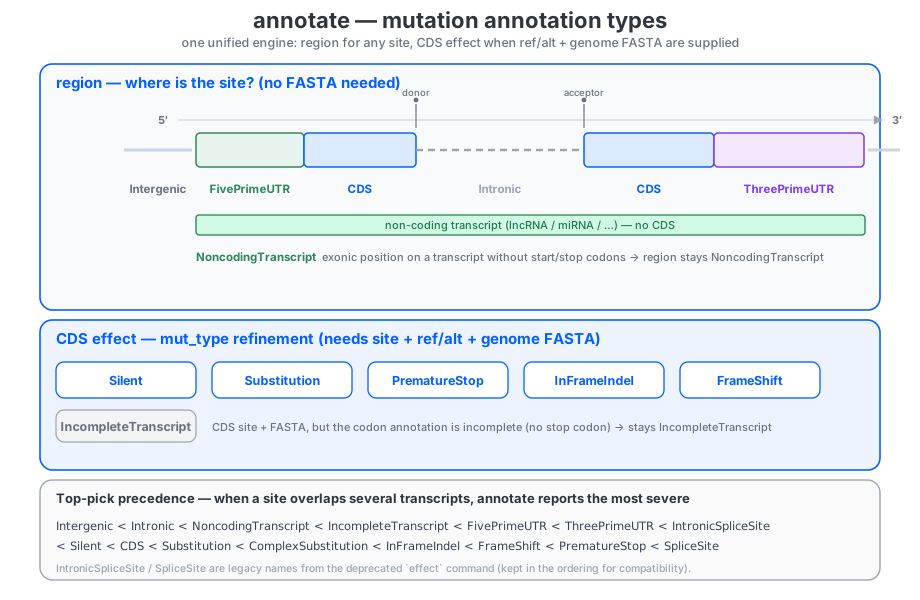
region — always filled; the position relative to the containing transcript (no FASTA needed):
| region | Meaning |
|---|---|
| Intergenic | Outside every annotated gene body. |
| Intronic | Inside a gene body but not in any exon. |
| NoncodingTranscript | Exonic, on a transcript with no start/stop codon (non-coding biotype). |
| FivePrimeUTR | Exonic, before the start codon. |
| CDS | Exonic, inside the coding sequence. |
| ThreePrimeUTR | Exonic, after the stop codon. |
mut_type — the region by default; refined for CDS sites when ref/alt and a genome FASTA (-f/--reference-transcript) are supplied:
| mut_type | Meaning | Emitted when |
|---|---|---|
| Silent | Codon change with no amino-acid change (synonymous). | CDS + ref/alt + FASTA |
| Substitution | Codon change altering the amino acid (missense, non-stop). | CDS + ref/alt + FASTA |
| ComplexSubstitution | Equal-length multi-base change (MNP). | CDS + ref/alt + FASTA |
| PrematureStop | Substitution introducing an in-frame stop codon. | CDS + ref/alt + FASTA |
| InFrameIndel | Net indel length is a multiple of three → frame kept. | CDS + ref/alt + FASTA |
| FrameShift | Net indel length not a multiple of three → frame shifted. | CDS + ref/alt + FASTA |
| IncompleteTranscript | CDS site on a transcript with incomplete codon annotation (e.g. no stop codon). | CDS + FASTA, incomplete transcript |
If several transcripts overlap one site, annotate reports the most severe annotation by default (severity order shown at the bottom of the figure) and all of them with -a/--all-effects. IntronicSpliceSite / SpliceSite are legacy names kept in the severity order from the deprecated effect command.
Python API
The commands are also importable functions.
from coralsnake.annotate import run_annotate, Annotation  # unified
from coralsnake.motif import get_motif
from coralsnake.coordinate import run_coordinate