Coralsnake
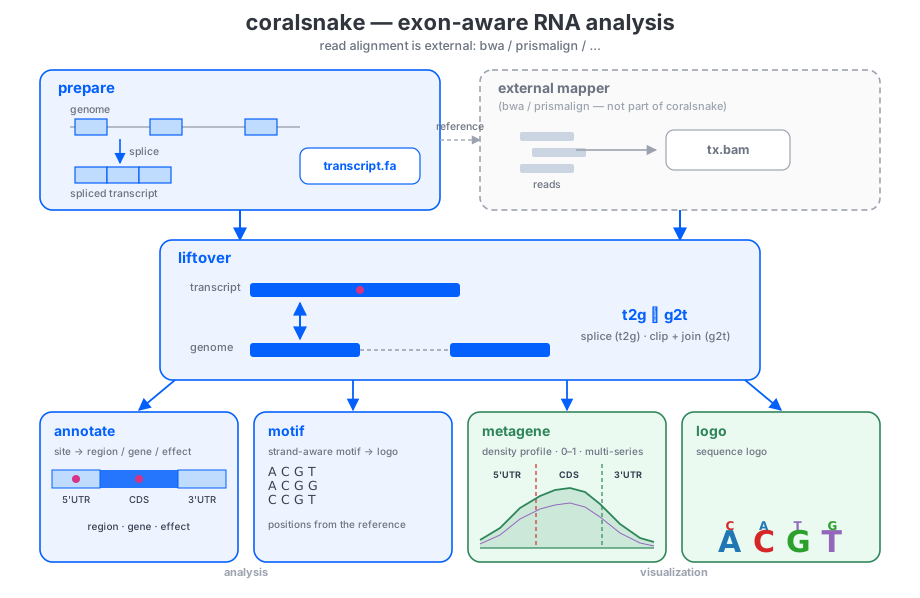
Conventional genomics tools are built around DNA — a linear, double-stranded reference where each locus lines up 1:1 with the sequence — and often lack explicit consideration of RNA’s structural properties: an abundance hierarchy (ribosomal rRNA is orders of magnitude more abundant than mRNA), strand orientation (sense vs. antisense), and splicing (mRNAs are assembled from exons, so a transcript does not line up with its genomic locus). Coralsnake is an exon-aware RNA analysis pipeline built around exactly these properties: it turns a GTF/GFF into spliced transcript references (prepare), splices and joins reads between transcript and genome coordinates in both directions (liftover), and runs the analyses you do on the results — annotate places sites/variants on the RNA hierarchy (5’UTR / CDS / 3’UTR / intronic / intergenic) and calls the variant effect, metagene profiles how sites distribute across 5’UTR / CDS / 3’UTR, motif fetches the strand-aware reference motif around each site, and logo renders a DNA/RNA sequence logo.
Installation
pip install coralsnake
The visualization commands (metagene plot, sequence logo) need the lightweight plot extra, which only pulls in matplotlib when you need it:
pip install "coralsnake[plot]"
Commands
| Command | What it does |
|---|---|
prepare | Extract the spliced primary transcript reference from GTF/GFF. |
liftover | Splice/join reads between genome/transcript BAMs (-d t2g default, -d g2t inverts). |
annotate | Unified site/variant annotation: region on the RNA hierarchy + gene/transcript + variant effect. |
metagene | Exon-aware metagene profiling across 5’UTR/CDS/3’UTR (profile plot needs coralsnake[plot]). |
motif | Strand-aware genomic motif fetch around variant sites. |
coordinate | Map chromosome names between coordinate systems (UCSC↔Ensembl). |
group | Group genes and build a consensus sequence. |
logo | Plot a DNA/RNA sequence logo (needs coralsnake[plot]). |
annotateis the single annotation tool — one command, one schema, two input modes:--reference-gtf(region + gene/transcript, and the full variant effect when given a genome FASTA + ref/alt) or--annotation <table>(fast precomputed-table site labeling).
Quick example
A typical end-to-end run (read alignment is done by any external mapper, e.g. bwa / prismalign):
# 1. Build the spliced transcript reference from the annotation
coralsnake prepare -g annotation.gtf -f genome.fa -o transcript.fa --with-txpos

# 2. Align reads to transcript.fa with an external mapper  →  tx.bam

# 3. Splice the transcript-aligned BAM back to genome coordinates
coralsnake liftover -d t2g -i tx.bam -o genome.bam -a annotation.tsv -f genome.fai

# 4. Annotate sites to genes/transcripts (RNA hierarchy + variant effect)
coralsnake annotate -i sites.tsv -o annotated.tsv \
                    --reference-gtf annotation.gtf \
                    --reference-transcript genome.fa -s -a

# 5. Exon-aware metagene profile across 5'UTR / CDS / 3'UTR
coralsnake metagene -i sites.tsv -g annotation.gtf -o profile.tsv -p profile.png
Documentation
- Architecture & Design — how the package is organized.
- CLI Reference — full usage of every subcommand.
- Python API — import the functions directly.
- Metagene — metagene profiling details.
- Logo — sequence-logo plotting details.
- Variant — genomic variant analysis subcommand group.
Mapping is out of scope. Nucleotide-conversion (two-color / three-color) mapping is not part of coralsnake any more: it lives in the dedicated
prismalignpackage (pluggable backends: bwamem, minimap2/mappy, pure-Python), on top of the lightweightbwamemBWA-MEM binding.